Mouth play I
Tuesday, October 19, 2010
The child learns through their mouth first. The mouth sensation develops even before their birth. Around 5 months in utero or womb the child brings the hands to mouth and sucks the hands. This is the first exposure of mouthing. After birth the child first exposure to mouthing is mother feeding. During feed the child does not even get touch sensation inside mouth but also around the mouth. This is favoured by rooting reflex which is a primitive reflex. According to Freud's psycho-sexual theory of development, the oral stage is a primary focus of libidal energy or libido. At the age of 3 months the child start bringing his hands in midline and starts mouthing. This way the child preoccupies with the pleasure of mouthing. Oral stage prepares the child for better oral functioning. It prepares the child for sucking, chewing and swallowing and later for speech.
Mouthing the toys and other objects helps the child to learn jaw control, chewing, tongue movement and speech. During this process the child learns to use different part and angles of the mouth. This prepares the child for transition of food from liquids to solids.
This is a normal process and most of the children undergo to this process by their own but it is not automatic process for children with special needs. They need assistance to learn it through guidance with early interventionist or occupational therapist.
Posted byNeeti at 10:43 PM 3 comments
Labels: autism, cerebral palsy, child disability, Down's syndrome, early intervention, occupational therapy, oral issues, parenting tips, play, primitive reflexes, sensory integration, speech therapy
Happy feeding
Thursday, October 14, 2010
Feeding to infant is difficult but pleasurable act. It is not only the source of the nutrition but also for emotional and early communication. Infant spends most pleasurable time with mother during feeding. However, feeding is not pleasurable to mother and child every time. Many a time it needs lots of effort from parents. But, little modification may bring comfort and pleasure to both.
1. The feeding position should be comfortable to both child and mother. Mother should be comfortable and have proper support in cradle position for infants and tailor position for toddlers. The child hands should be placed forward and head tilted little forward. This helps in smooth swallowing and prevents choking and aspiration. This position not only provides stability but also opportunity for eye contact and early communication of their emotions. This position also helps in head control and midline orientation. It is important for children with Down’s syndrome and cerebral palsy. For children with special need, this position avoids the excess air intake which may lead to stomach cramps.
2. Environment plays an important as well. The environment should be calm and less distraction. The act should be pleasurable by adding some music or singing lullabies
3. Mouth play is important for developing better oral functioning and speech
Enjoy feeding!!!
Posted byNeeti at 11:44 PM 2 comments
Labels: cerebral palsy, Down's syndrome, early intervention, feeding, nutrition, parenting tips, sensory integration, speech therapy
My child does not speak...
Friday, October 8, 2010
Child development is amazing. All the developmental milestones are fixed but flexible. Many a time child does not follow the sequence and time but most of the children follow the predictable developmental sequence. Parents always keep a track of their child development. However, many a times the parents miss the track and most common is the speech and communication delay. There are many myths and mis-believes are associated with the speech development. Many say the girls speak earlier than boys or someone spoke late in the family so the child is granted to speak late. Here we forget to face the reality. It may happen the child may catch the pace of development but what would happen if it does not catch the pace? In that ignorance we lose the critical period of child development.
There are few red flag sign like
- Not speaking or uttering specific words at 15 month
- Not responding to his/her name
- Not understanding the simple commands
- No social communication
Either one or all symptoms are present….the only mantra that’s works is an immediate evaluation
Evaluation may point to
- Developmental delay
- Autism
- Hearing loss
- Speech and language disorder
- Other less known conditions (deprivation/abuse, cerebral palsy, central auditory processing disorder, Landau-Kleffner Syndrome, selective mutism)
Early detection and evaluation may assess the risk factors. Early intervention may provide the opportunity for the child to improve significantly. Early intervention is must for all children who are deviated from their normal development.
Posted byNeeti at 11:33 PM 0 comments
Labels: early intervention, parenting tips, red flag sign, speech therapy, Therapy
Gandhi Jayanti Celeberations
Thursday, October 7, 2010

Sometimes in life fate takes you back to your past. It makes you wonder that how beautiful those days were and how different things were during those days. Going down the memory lane you recollect all those events and you wish if few things had stayed the same.
But the truth is that past is a foreign country where things are beyond our control. However, what we can certainly do, is that, we can take assertive actions to turn the dreams of our past into the realities of our future.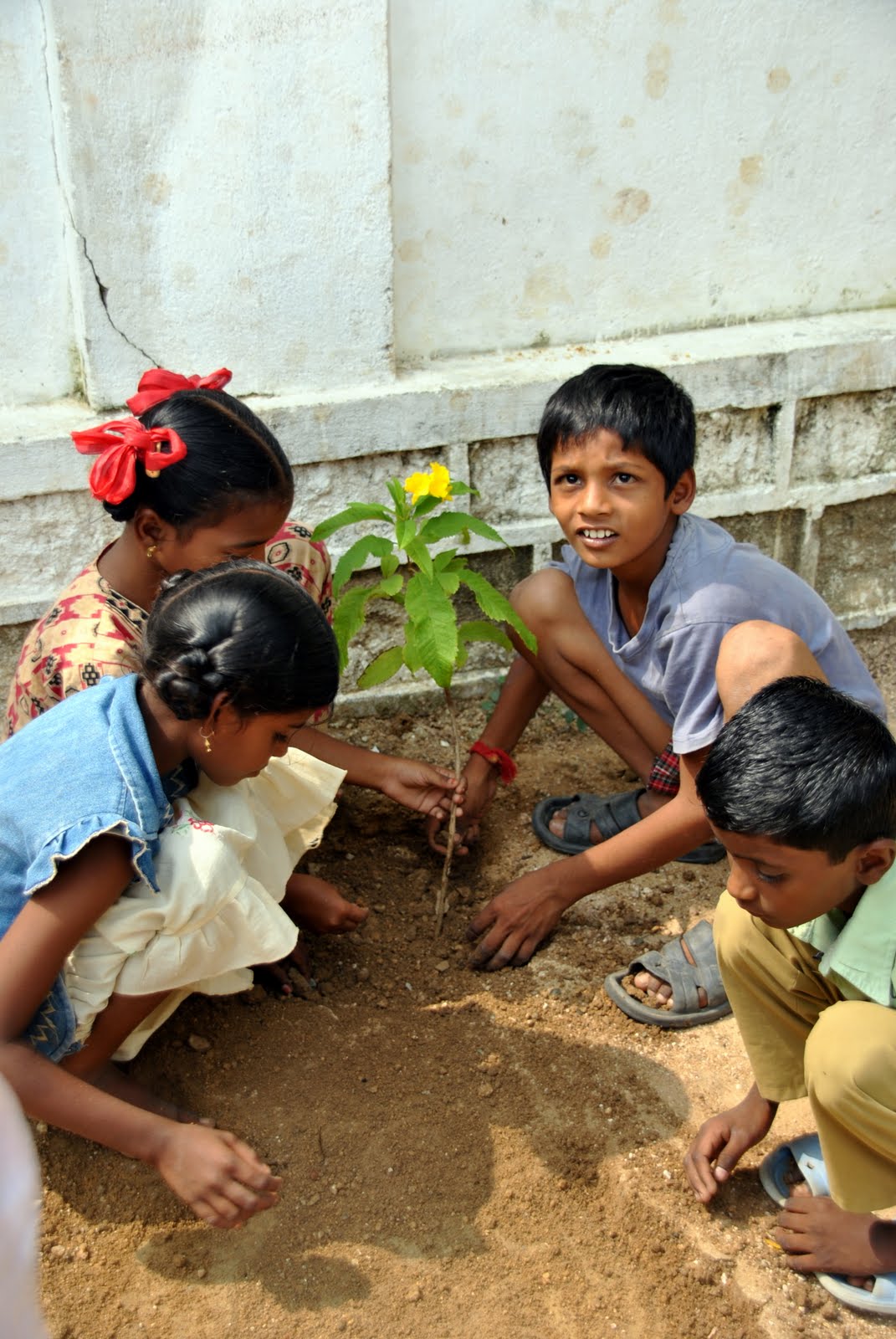
This 2 October Sakshum endeavoured to take one such action. The father of our nation once dreamt of education that builds nation by polishing characters of our youth. He believed that education is much more than an asset which enables you to earn money.
This 2 October Sakshum decided to live this dream. Contrary to a normal school day, this day started by enlightening the students of the school about issues related to environment.They were given a presentation which showcased the challenges that our environment is currently facing and steps which can avert these unwanted changes. The enthusiasm shown by the students starkly manifested their hunger for the education of the subject. Theory was then succeeded by some practical. Now kids were asked to plant saplings in the school campus and here again the kids did not stop to surprise us. It sometimes bewilders you when you see kids enjoying some activity which is insipid by your understanding- they did not only plant trees but also spawn a relationship with them. It was heartening to witness such gusto among kids.
The event culminated with a drawing competition. Almost every kid based his painting around nature. It appeared that these kids already knew what we wanted to convey- as if some divine power is assisting us. They always remind you the true human nature which loves being in nature and exploring it.
There is no doubt about the fact, that more often than not we learn from them rather then teaching them. The biggest challenge is to preserve the basic goodness in them that every human is bestowed with.
We wish that these kids stay the same and nurture there basic human traits. May they all turn into Vaishnav Jan like our Bapu always wanted them to be. Amen!
P.S.- Here is the link for the pics of the event.
Posted byGoofy at 8:31 AM 0 comments
Labels: 2 October, celebrations, Gandhi Jayanti
Independence day celebrations at our adopted school
Sunday, October 3, 2010
Posted byMeera at 10:30 PM 0 comments
Labels: adopt a school project, celebrations, early intervention
Child development and Early intervention
Sunday, September 26, 2010
Most of the parents have concerns about their child development. Many of them often visit to paediatricians for regular physical and well being check-ups. In our countries due to the lack of awareness, many a time the development screening either does not complete or remains superficial. Moreover the paediatricians are busier in immunization or vaccination. Many a time they miss the developmental delay or forget to refer to early interventionist or developmental paediatrician for further evaluation.
Here as a parent, you should be aware of child’s development and behavioural growth so that you can share your concerns with the professionals and if there are issues then you can intervene earliest.
DEVELOPMENT
All children go through developmental “stages” in various developmental areas like motor, fine motor, cognition, speech and language etc – typical and predictable changes in the areas.
The next stage of development depends on the previous stage and hence they are interrelated.
Every child develops on his own pace.
DEVELOPMENTAL SCREENING
- The checklist which guides the child development with respect to normal population. Experts have developed a list of developmental milestones in all development areas. Most of the time, it is conducted by psychologist, early interventionist or a developmental paediatrician.
- Screening includes interactive session between parents and specialist. This may include a checklist or questionnaire about the family, prenatal, natal or antenatal history. The developmental history includes all developmental areas.
- According to evaluations and results, recommendations are made for further services.
IMPORTANCE OF DEVELOPMENTAL SCREENING
To determine the healthy growth of the child and to monitor the child development.
To detect the developmental issues at earliest and intervene early.
CONTACT
Child’s paediatrician or EARLY INTERVENTIONIST or child psychologist can provide developmental screening.
Posted byNeeti at 11:09 AM 0 comments
Labels: autism, child development, child disability, child education, early intervention, education, knowledge sharing, parenting tips, red flag sign, screening
TV the idiot box...
Wednesday, September 22, 2010

Most of the times parents of children with language or communication delay complaint or have concern about their children watching television for longer time. Recently a parent approached me and had a concern that child talked very less and whatever he talked was monotonus or like parrot talking. During assessment it was found that both the parents were on full time work and they left the child at home alone. A nanny took care of him and most of the time child was kept in front of cartoon channel and there was very less human communication with child.
Other child of 6 years was indulged in watching a DVD. She had almost memorize the whole DVD and she could repeat the whole DVD without mistake. most of the time, child was preoccupied with the self talking and it was all about the DVD content.
Researches have proven that excess TV watching is associated with delayed language development. Research on early brain development shows that babies and toddlers have a critical period for speech and communication development and that needs direct interactions with parents and other significant care givers for healthy brain growth and the development of appropriate social, emotional, and cognitive skills. Children who watched television alone were 8.47 times more likely to have language delay when compared to children who interacted with their caregivers during television viewing. As recommended by the American Academy of Pediatrics (AAP), children under the age of 2 should watch no television at all, and after age 2 watch no more than one to two hours of quality programming a day. Therefore, exposing such young children to television programs should be discouraged. Parents should engage children in more conversational activities to avoid television-related delays to their children language development, which could impair their intellectual performance.
Posted byNeeti at 10:01 PM 2 comments
Labels: autism, child disability, child education, children, communication, developmental disability, disability, early intervention, education, Learning disability, parenting tips, speech therapy
